SMP Scar Camouflage in Johannesburg: Concealing FUE, FUT & Scalp Scars with Precision Micropigmentation
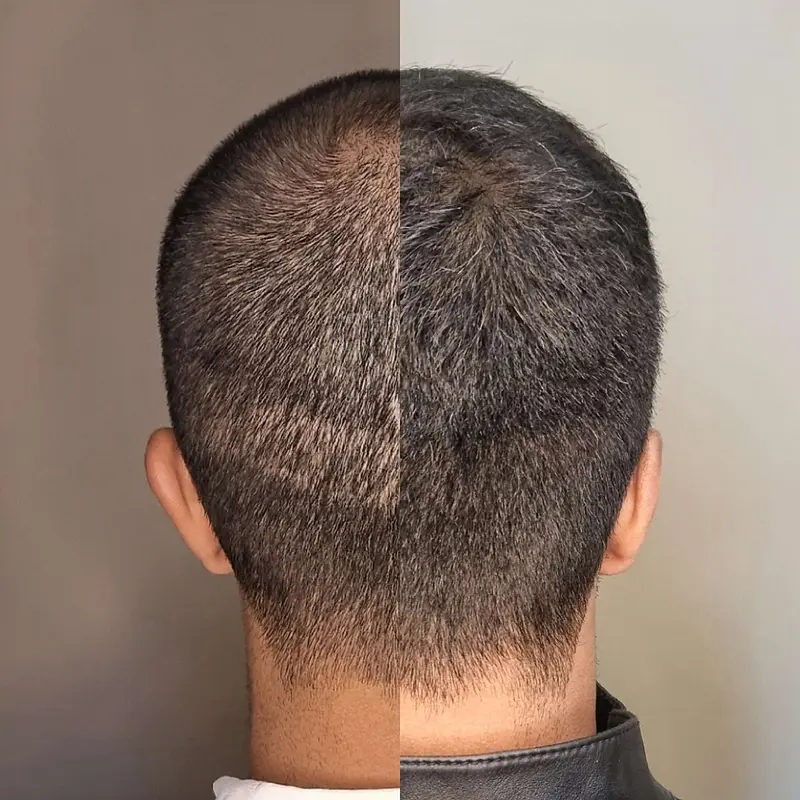
For many men who undergo hair transplant surgery, the primary regret is not the procedure itself, but the visible scars left behind. Whether you have a wide horizontal strip scar from an older FUT (Follicular Unit Transplantation) procedure or scattered white "moth-eaten" dot scars from an FUE (Follicular Unit Extraction) procedure, these marks often prevent you from ever wearing your hair short.
Fortunately, SMP Scar Camouflage in Johannesburg offers a permanent, non-surgical solution that conceals surgical and traumatic scalp scars, restoring your freedom to buzz your hair down with complete confidence.
How Scalp Micropigmentation Conceals Transplant Scars
Scar tissue lacks melanin, blood supply, and hair follicles, making it stark white or pale pink compared to the surrounding scalp. When you buzz your hair, the contrast between dark stubble and white scar tissue creates an eye-catching line or pattern.
Through microscopic precision, our lead practitioner Chanieël du Plessis deposits carbon-based pigments directly into and around the fibrous scar tissue. By breaking up the stark borders of the scar and replicating individual follicle impressions at varying depths, the scar visually disappears into the surrounding hair.
Types of Scars We Treat at Our Sandton Studio
- FUT Strip Scars: The classic linear scar across the back and sides of the head. We feather impressions through the scar tissue to break up the continuous line.
- FUE Punch Scars: Hundreds of micro-circular scars caused by over-harvesting donor hair. We deposit micro-droplets in each pale void to match the surrounding density.
- Neurosurgical & Trauma Scars: Scars resulting from childhood accidents, surgery, or sports injuries where hair permanently ceased to grow.
- Burn Scars & Facelift Incisions: Scar tissue around the temples and sideburns common after reconstructive or cosmetic surgeries.
Why Scar Tissue Requires Advanced SMP Expertise
Treating scar tissue is dramatically different from working on regular scalp skin:
- Variable Skin Density: Scar tissue can be either hypertrophic (raised and dense) or atrophic (thin and fragile). A practitioner must adjust needle angle, pressure, and frequency with surgical precision.
- Pigment Retention: Scar tissue often rejects pigment more quickly during the initial session. A strict 3-session layering protocol ensures pigment settles permanently without migrating.
- Custom Colour Matching: Because scar tissue absorbs light differently, colour formulations must be subtly dialed to avoid unnatural darkening.
How Many Sessions Are Required for Scar Camouflage?
Most scar camouflage clients require 2 to 3 sessions spaced 10 to 14 days apart. During your first session, we test pigment absorption on the densest part of the scar. Subsequent sessions build multi-layered density until the scar seamlessly blends with the natural hair pattern.
Book Your Private Scar Assessment in Sandton
Are you tired of hiding the back of your head or wearing caps to conceal transplant scars? Send a high-resolution photo of your scar to our Sandton studio via WhatsApp at 082 740 4690. We will assess the tissue maturity, discuss achievable coverage, and give you an immediate fixed quote.
SMP South Africa is based in Sandton, Johannesburg. Contact us at 082 740 4690 for a free consultation.